
What if your low mood, your restless nights, and the belly fat that won’t budge weren’t personal failures — but symptoms of something almost everyone has quietly lost?
The Question Nobody’s Asking
Millions of people are struggling with depression, anxiety, poor sleep, and stubborn weight — and most of them are getting the same answer: try a new medication, eat less, stress less, exercise more.
But what if the real answer is microscopic? What if there’s a single organism — one that used to live inside virtually every human on the planet — whose disappearance is quietly contributing to all of those problems at once?
That organism is called Lactobacillus reuteri, or L. reuteri. And according to cardiologist and author Dr. William Davis — who wrote Wheat Belly and Super Gut — an estimated 96% of modern people no longer have it in meaningful amounts.

That number is striking. And the story of how we lost it — and what happens when you get it back — is even more so.
Your Gut Is Running Your Brain (More Than You Think)
Before we get to the microbe itself, there’s something worth understanding that most people have never been told.
Your gut isn’t just a digestion machine. It functions almost like a second brain — and the two are in constant communication through a nerve called the vagus nerve. That connection runs both ways: what happens in your gut affects your mental state, and your mental state affects your gut.

Your gut microbiome — the trillions of bacteria living inside you — plays a central role in how much serotonin, dopamine, and GABA your body produces. These are the neurotransmitters that regulate mood, focus, sleep, and your ability to handle stress. When the microbiome is disrupted, less of those get made. The brain feels it.
This is why gut health and mental health are so deeply intertwined. It’s not just a metaphor. There’s a genuine biological mechanism at work.

How We Lost It — And Why It Matters
L. reuteri isn’t some exotic probiotic that humans recently discovered. It appears to be a microbe we were always supposed to have.
Wild animals have it. Indigenous peoples living in the Amazon or the highlands of Papua New Guinea — people who’ve never been exposed to antibiotics — have it. Sequence the gut of nearly any wild mammal, and you’ll find it. It looks, in other words, like a natural part of what a healthy mammalian gut is supposed to contain.
So what happened to the rest of us?
Antibiotics are the biggest culprit. L. reuteri is highly susceptible to common antibiotics — meaning a single course of amoxicillin, even decades ago, may have wiped it out entirely. And unlike some bacteria that bounce back after antibiotic use, L. reuteri often doesn’t return on its own.
Add in glyphosate (an herbicide found in many processed foods), ultra-processed diets, chronic stress, alcohol, and environmental pollution — and you’ve got a long list of modern factors that all work against this one organism.

What People Notice When They Restore It
This is where things get interesting — and admittedly, where the reports start to sound almost too good to be true.
Dr. Davis has been tracking thousands of people who’ve restored L. reuteri through fermentation (more on how to do that shortly), and what he describes is a consistent pattern of improvements that mirrors what was first observed in animal studies at MIT.
Here’s what people commonly report:
| WHAT PEOPLE REPORT | POSSIBLE MECHANISM |
|---|---|
| 😴 Deeper, more restorative sleep | L. reuteri produces ergothioneine, a compound observed in research to protect against stress-related sleep disruption |
| 😊 Noticeably improved mood | Increased oxytocin production, which helps lower cortisol — the stress hormone linked to anxiety and depression |
| 💪 Improved muscle tone | Oxytocin and microbiome restoration appear connected to muscle preservation in aging, per animal studies |
| 📉 Reduced belly measurements | Shifts in gut bacteria composition may influence how the body stores abdominal fat |
| ✨ Skin appearance improvements | Anti-inflammatory effects; clinical trial participants reported visible skin changes |
| 🛡️ Fewer minor illness episodes | Presumptive immune system support from restored small intestine colonization |
It’s worth being clear: everyone’s experience varies, and this isn’t a guarantee of any specific outcome. These are patterns that people have reported — not medical claims. But the consistency across thousands of accounts is hard to dismiss.
The Sleep Connection
The sleep piece deserves its own mention. A study published in Translational Psychiatry found that L. reuteri produces a compound called ergothioneine. In animal models, this compound showed a protective effect against stress-induced sleep disturbances — particularly disruptions to REM sleep, which is the deep, restorative phase most linked to mood regulation and memory.
Many people who restore L. reuteri report that this is actually the first thing they notice — falling asleep more easily, staying asleep, and waking up feeling genuinely rested rather than just “less tired.”
The Belly Fat Connection
In a small clinical trial Dr. Davis ran, women were given L. reuteri without being asked to change their diet or exercise habits. The original goal was to measure skin improvements — and those showed up. But when he measured waist circumference almost as an afterthought, the results surprised him.
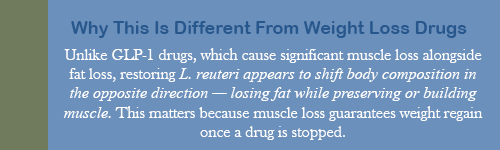
Participants lost significant inches off their waist — some up to eight and a half inches — without dietary changes. And the scale didn’t always budge. The likely reason: while abdominal fat was decreasing, muscle mass appeared to be increasing. A shift in body composition rather than just weight loss.
The Bigger Picture
What makes the L. reuteri story compelling isn’t any single benefit — it’s the fact that one organism seems to touch so many systems at once: mood, sleep, body composition, immune function, skin health.
That makes sense when you step back. We’re not talking about a supplement that was designed in a lab to do one thing. We’re talking about restoring something that mammals — including humans — were always supposed to have. When a foundational piece goes missing for decades, its return can create ripple effects across the whole system.
If you’ve been struggling with mood, sleep, or weight despite doing “all the right things,” it might be worth asking whether the missing piece isn’t discipline or the right diet plan — but a microbe your gut was always supposed to contain.

How to Make Dr. Davis’s L. Reuteri Yogurt
Here’s the key insight that makes this work: you can’t get the benefits by just taking L. reuteri as a standard probiotic supplement. Commercial tablets contain doses so small that most people notice nothing at all.
The trick is fermentation. Specifically, 36-hour fermentation at body temperature (99°F). L. reuteri doubles roughly every three hours at that temperature. After 36 hours — 12 doublings — you end up with approximately 300 billion live organisms per serving. That’s roughly a thousandfold more than what’s in a standard tablet.

What You’ll Need
| INGREDIENT / ELEMENT | DETAILS |
| L. Reuteri Probiotic | 1 capsule — strain matters. |
| Inulin (prebiotic fiber) | 1 tablespoon — this acts as food for the bacteria so they multiply during fermentation. |
| Organic Half-and-Half | 1 quart — full fat gives the best texture and the richest consistency. |
| Yogurt Maker | Any standard countertop model works. You need temperature control down to 99°F. |
| Fermentation Time | 36 hours exactly — this is the sweet spot. Less time, and you lose count; more time and bacteria begin to die off. |
Step-by-Step Instructions
Step 1: Open your probiotic capsule and empty it into a small bowl. Add one tablespoon of inulin. (See note below about the MyReuteri, Complete Starter Culture). Mix together with about two tablespoons of organic half-and-half — just enough to make a smooth paste with no clumps. This may take a couple of minutes.
Step 2: Pour in the rest of the quart of half-and-half and stir everything together thoroughly.
Step 3: Pour the mixture into your yogurt maker containers. Fill the outer water reservoir to the same level as the mixture inside the containers.
Step 4: Set the temperature to 99°F. Set the timer to 36 hours, NO less! Put the lid on and walk away. Don’t stir it, don’t check it — just let it ferment undisturbed.
Step 5: After 36 hours, transfer to the refrigerator for a couple of hours to set and cool.
Step 6: Consume half a cup per day. Many people find taking it right before bed lines up well with the sleep benefits they experience. You can eat it plain or add berries and/or honey — most people find it genuinely delicious on its own.
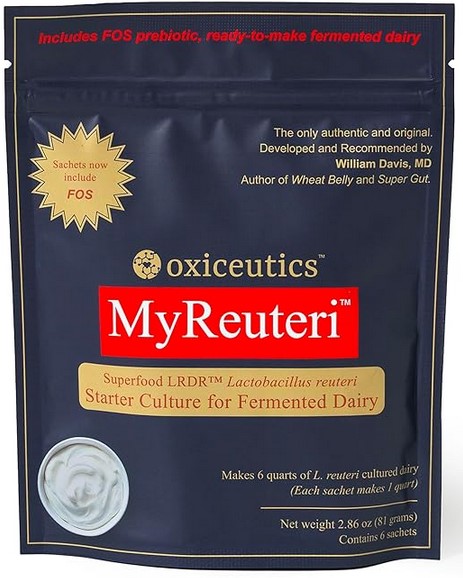
Note: The easiest way to start making the yogurt! You can also use a packet of MyReuteri Complete Starter Culture, in place of the L. reuteri capsule and inulin, as the packet contains both.
Disclaimer: This post shares information about what many people have found helpful — it is not medical advice. If you have existing health conditions, are pregnant, or are taking medications, speak with your healthcare provider before making significant changes to your diet or supplement routine.
As an Amazon Associate, I earn from qualifying purchases. This means if you click on a link and buy something, I may receive a small commission at no extra cost to you.